News

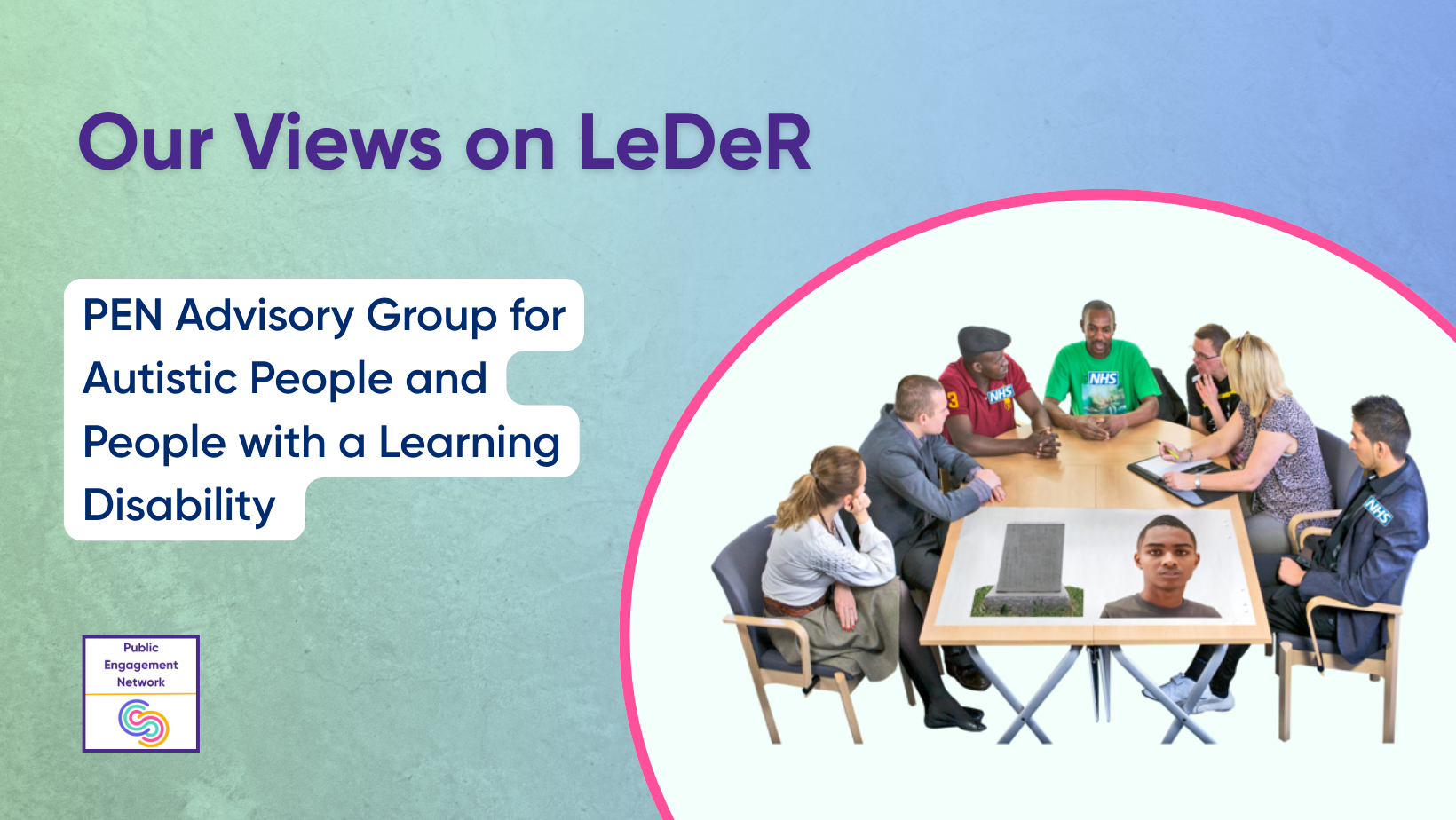
PEN Advisory Group members share their views on the Lives and Deaths of People with a Learning Disability and Autistic People (LeDeR)

PEN Newsletter Designs 1

“LeDeR tells us where we are at the moment in healthcare”, a member of the PEN Advisory Group for Autistic People and People with a Learning Disability told us.

Views on the report's delay

The group agreed that the delay in the report’s publication was disappointing. The data in the latest report is from 2023.

They said the delay means it is difficult to compare data with other reports and has meant that families have been waiting for the results for an extended period. “The delay was frustrating. It’s our lives”, one member told us.

Advocates and not for profit organisations have also been impacted since they may be reliant upon the data published in LeDeR in their work.

Accessibility

The group were pleased that this year’s report included an Easy Read version and a video explainer which they said made the report accessible, including to people who can’t read. “You can watch the video with someone and go through it”, they said. Another member added “I’m classed as high-functioning autistic and I struggled with the report, so the Easy Read version was great.”

Inclusion

Some PEN Advisory Group members felt that the report lacked the voices of people with a learning disability and focused too much on data. “The report doesn’t show how many people are not receiving the care they need. We need to know the truth about what people with learning disabilities are experiencing”, especially given that cases of abuse in supported living settings have been reported in recent years. They argued that some people are not being heard, particularly those with severe and profound learning disabilities and those who don’t have parents, whose needs are often overlooked.

They added “There is not very much in the report on Autism without a Learning Disability. Our lives and deaths matter too.”

Reasonable adjustments

The LeDeR report found that the quality of care had improved in comparison to previous years but 37.2% faced delays in care or treatment, and 27.3% were reported to have needed at least one reasonable adjustment that they were not provided with.

“People need to know what their rights are”, PEN Advisory Group members told us. “The people I’m worried about are people who can’t ask questions to services because they don’t use words to communicate”.

They said “not every Hospital accepts or uses Autism Health Passports. We’re effectively ignored and reasonable adjustments aren’t considered.” “How are people supposed to know what reasonable adjustments can be made?” they asked.

Several told us that they found themselves having to repeat their reasonable adjustment needs to GP services, for instance in having longer appointments, even when these were included in their records. “People give up asking for reasonable adjustments or care needs if they have to keep repeating themselves”, they said.

Next steps

PEN Advisory Group members told us what they would like to see happen as a result of the LeDeR Report:

  • We need to recognise that autistic people and people with learning disabilities want to take part in improvements to their health. They must be included in this.
  • Are the Care Quality Commission (CQC) asking the right questions and assessing how services are making reasonable adjustments? We need to learn from best practices as well as from what’s going wrong. This is something we can do through PEN to help create positive change.
  • We need to take the time to learn from the report and to assess what can be done to improve healthcare for autistic people and people with a learning disability. It’s down to the UK government to make changes and there should be MPs who can be contacted and held to account.
  • Autistic people and people with a learning disability can find hospitals very difficult sensory environments to be, and so they may try to avoid them. There needs to be specialised training to increase the number of learning disability nurses and autism nurses for both primary care and hospitals.
  • There should be a greater recognition of the needs of people with a learning disability and autistic people who often worry about bothering doctors and feel that they are making a fuss. This means they may miss vital signs and appointments which then affects their health.
  • We would like to see more awareness-raising and education around lung infections, bowel cancer screenings, and what to do if someone is having an epileptic fit.
  • There needs to be greater continuity of care. It takes time to build a relationship of trust with GPs, nurses and support workers, particularly around health issues that some people may not feel comfortable talking about such as constipation. This would also mean that we would not have to keep repeating our reasonable adjustment needs.
  • There needs to be more joined-up working between different services and sectors. The Prison Report showed that there is a connection between people with a learning disability, mental health and prisons. We need to start looking at the bigger picture of people with learning disabilities’ lives.

Care Quality Commission (CQC) response

‘The details in the latest LeDeR report do not come as a surprise but remain shocking and disappointing. It is not acceptable that we still live in a world where autistic people and people with a learning disability face inequalities in accessing the care and treatment they need.

It is intolerable that people experience poorer outcomes and premature death in an age where medical understanding, technology and treatment is constantly improving.

At CQC, we understand that, for change to happen, people’s voices must be heard and their experiences understood alongside a real commitment to improve the services people rely on. Accessibility supported by good communication, appropriate reasonable adjustments and timely diagnosis and treatment are key.

We remain dedicated to improving the health outcomes for autistic people and people with a learning disability. We will listen, we will act and do all we can to be part of the solution.’

Paula Eaton, Deputy Director (for people with a learning disability and autistic people), the Care Quality Commission (CQC)

Learn more

The details in the latest LeDeR report do not come as a surprise but remain shocking and disappointing. At CQC, we understand that, for change to happen, people’s voices must be heard and their experiences understood alongside a real commitment to improve the services people rely on. We will listen, we will act and do all we can to be part of the solution Paula Eaton, Deputy Director (for people with a learning disability and autistic people), the Care Quality Commission (CQC)

Black Lives Matter 1640 800px 1640 775px

PEN Autistic People and People with a Learning Disability's Advisory Group

The Public Engagement Network invites autistic people and people with learning disabilities to join our Advisory Group

Read more
PEN Newsletter Designs 1640 900px 1640 880px 1640 810px 8

News

Public Engagement Network (PEN) updates and shared stories from our members

Read more
Black Lives Matter 1640 800px 1640 775px 4

Contact PEN

Send a message, phone us and connect with us on social media here

Read more